

What if global warming could be cooled down almost immediately, not by rebuilding the entire world economy, but by reflecting about 1% more sunlight back into space?
That is the unsettling simplicity behind the aerosol argument. While governments, corporations, and the trillion-dollar green industry keep pushing expensive long-horizon solutions, a materials scientist and YouTuber, Thunderf00t (videos at the bottom), is making a much more direct case: if the climate problem is partly an energy-balance problem, then a practical way to cool the planet is to reduce a tiny fraction of the solar energy reaching it.
That is not magic. It is not speculative fantasy. It is basic physics.
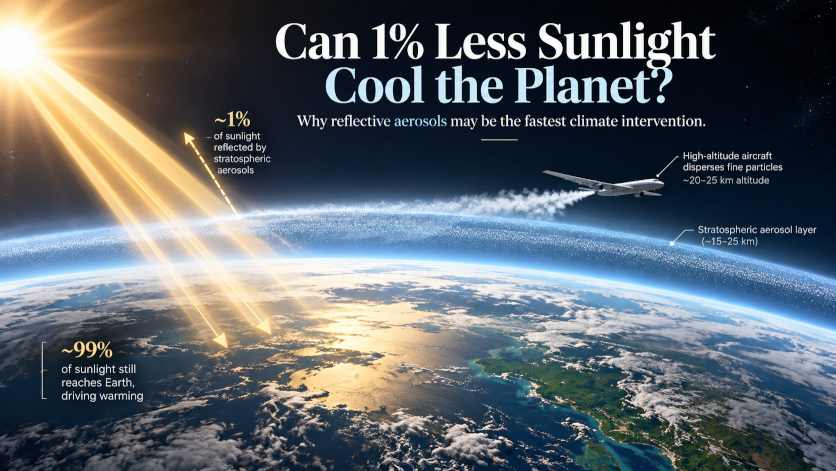
The basic idea is almost embarrassingly simple
Most climate policy is focused on carbon dioxide. That makes sense in one way, because CO₂ is the long-lived gas driving most of the warming. But there is a major catch: even if emissions are cut, the temperature response is slow. CO₂ already emitted remains in the atmosphere for a long time, and replacing global energy infrastructure is slow, expensive, and politically messy.
Reflective aerosols attack the problem from the other end.
Instead of trying to remove centuries of accumulated carbon from the sky, the idea is to put carefully selected particles high in the atmosphere so they scatter a little more incoming sunlight back into space. If less solar energy is absorbed, the planet cools.
That is why this approach gets attention. It does not depend on waiting decades for a complete energy transition. It aims directly at temperature.
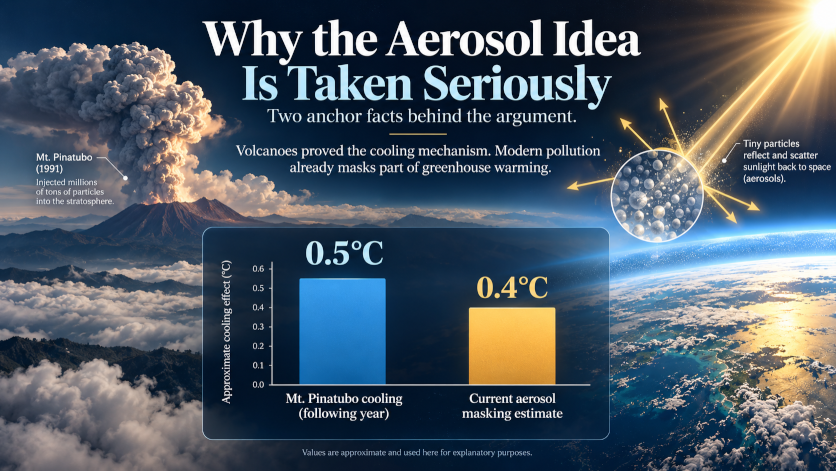
And we already know the mechanism works. Nature has run the experiment for us. After major volcanic eruptions, particles injected into the stratosphere temporarily cool the planet. Mount Pinatubo is the standard example. The principle is real. The debate is not whether aerosols can cool Earth. The real debate is how to do it deliberately, safely, and at scale.
The uncomfortable economic comparison
This is where the argument becomes politically radioactive.
If a climate intervention can cool the planet quickly, and if it can be done for a fraction of what the global energy transition costs, then a lot of people with money, institutions, and reputations tied to the current climate narrative are going to be very uncomfortable.
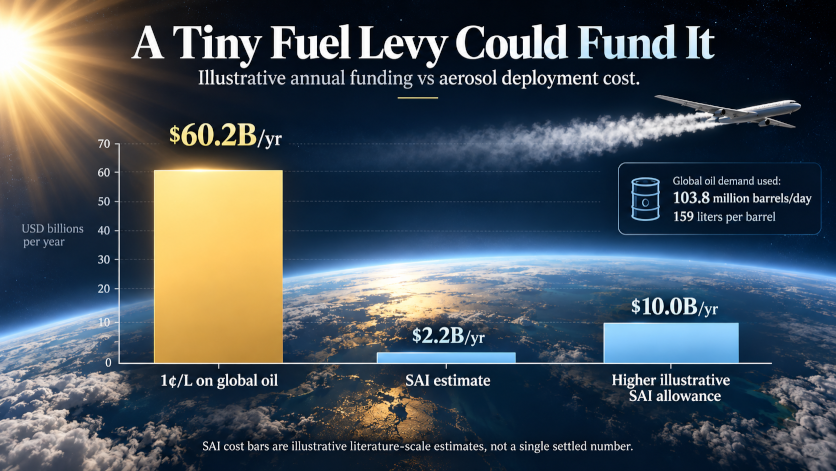
The case made in the video is that a serious aerosol program could be funded for something on the order of one cent per litre of petrol. Even allowing for uncertainty, infrastructure, aircraft, research, monitoring, logistics, and margin for error, the scale is tiny compared with the multi-trillion-dollar cost of restructuring the global energy system.
That does not mean the aerosols are literally “free.” Of course they are not. Manufacturing and dispersing enormous quantities of material is still a major industrial project. But compared with the size of the global oil economy, or compared with the enormous cost of many green-energy schemes, it is still a remarkably small bill.
That is what makes the proposal so disruptive. It does not merely claim to help. It claims to help fast, and at a cost the world could actually carry without economic self-destruction.
The irony nobody talks about enough
There is another point that makes this even more awkward for the standard climate script.
A sudden drop in fossil-fuel burning would not necessarily produce an immediate drop in temperature. In fact, it could briefly do the opposite.
Why? Because burning fossil fuels does not only release greenhouse gases. It also releases short-lived particles and pollutants that reflect sunlight and brighten clouds. Those dirty aerosols are unhealthy and undesirable in many ways, but they also mask part of the warming. If they disappear quickly while the accumulated CO₂ remains, the short-term result can be a bump in warming.
That means the public has been sold a simplified picture for years: stop emissions, stop warming. In reality, the system is more complicated. Emissions cuts matter immensely in the long run, but they do not act like a light switch for global temperature.
Aerosol intervention, by contrast, acts directly on incoming energy. That is why it could cool much faster.
This is one of the strongest parts of the argument. It explains why a direct radiative intervention can look brutally effective compared with the slow grind of decarbonisation alone.
Why people will resist it anyway
Even if the physics works, the politics and public psychology are brutal.
Try pitching this to the average person in one sentence:
“We want to spray particles into the atmosphere to block a little sunlight.”
That sounds like the plot of a villainous sci-fi film.
People are already suspicious of establishment science. Many feel they were misled in recent years on a range of issues. Public trust has been damaged by exaggerated claims, overconfident messaging, selective reporting, and repeated doomsday framing that often oversimplifies uncertainty. Add to that the long-running “chemtrail” conspiracies, and now imagine asking the public to support an actual atmospheric aerosol program.
On top of that, sunlight is emotionally and biologically loaded. People think of health, nature, food, seasons, and vitamin D. Even if the proposed reduction is tiny in global percentage terms, the phrase “blocking the sun” triggers fear instantly.
So yes, this is an uphill battle. Probably a massive one.
But that does not change the central point: this time the mechanism appears to work. The difficulty is not that the idea has no physical basis. The difficulty is convincing a distrustful public to accept a solution that sounds insane at first hearing.
![“Why Aerosols Could Cool Fast” timing graph comparing three curves: status quo warming, rapid decarbonization alone, and aerosol cooling response, showing that aerosol cooling acts quickly while CO₂ cuts help more slowly.]](https://docjulien.me/wp-content/uploads/2026/09/ChatGPT-Image-Sep-25-2026-07_16_30-AM.png "The One-Percent Climate Fix Nobody Wants to Talk About")
Is this a complete solution?
No. And it does not have to be.
Reflective aerosols do not remove carbon dioxide from the atmosphere. They do not fix ocean acidification. They do not eliminate the need for energy innovation, efficiency, or better land use. They also raise serious questions: what material is best, what altitude is optimal, how are side effects monitored, what happens to rainfall patterns, who governs deployment, and what happens if a program begins and then stops suddenly?
Those are real questions.
But they are not reasons to dismiss the whole concept as unserious. If anything, they are reasons to study it harder.
What makes the aerosol case compelling is not that it promises a perfect world. It is that it offers something climate policy rarely offers anymore: a physically plausible intervention that could produce meaningful temperature effects on a human timescale.
That alone makes it impossible to ignore.
Why this idea matters
For years, much of the climate conversation has revolved around sacrifice, restriction, and gigantic cost. People are told they must consume less, travel less, pay more, and restructure society, all in exchange for benefits that often sound distant, abstract, or uncertain.
Then along comes an argument saying: maybe we can cool the planet by engineering the atmosphere directly, using a comparatively small amount of material, for a comparatively small cost, and see an effect quickly.
Of course that idea will be attacked. It threatens too many narratives at once.
It threatens the idea that only vast social transformation can “solve” climate change. It threatens industries built around expensive pathways. It threatens the prestige of people who have spent years implying that simple approaches are naïve. And it threatens the emotional appeal of apocalyptic politics.
But the atmosphere does not care about ideology. It responds to physics.
If tiny reflective particles high in the sky can reduce incoming solar energy enough to cool the planet, then that fact matters whether it flatters anyone’s preferred agenda or not
Final thought
I am not saying aerosol intervention is risk-free. I am saying it deserves to be taken seriously precisely because it is one of the few proposals that seems capable of affecting temperature quickly, cheaply, and at global scale.
That is why this YouTuber’s argument lands so hard.
He is not offering another fantasy about turning atmospheric carbon into premium consumer products or waiting for a miracle industrial revolution to arrive on time. He is pointing to a blunt, practical lever: reflect a little more sunlight, and the planet cools.
Maybe the biggest obstacle is not the chemistry.
Maybe it is that the solution is too simple, too cheap, and too effective-looking for the current climate establishment to embrace comfortably.
And maybe that is exactly why more people should look at it.
Source/Inspiration/Credits
 FR
FR  EN
EN
I’m holding back quite a lot on this one, guys.
Actually, I’m feeling more strongly about this. About how corrupt the scientific and political community – not the conservatives who genuinely believe in letting the free market handle itself – the liberals who pretend to help but their idea to fight global climate effects is always: spend more energy and invent new ways to consume expensive products. When renewables (forestry), and simple solutions (aerosols) exist already but are swiftly ignored. Because there’s just no money to make in finding immediately effective solutions….