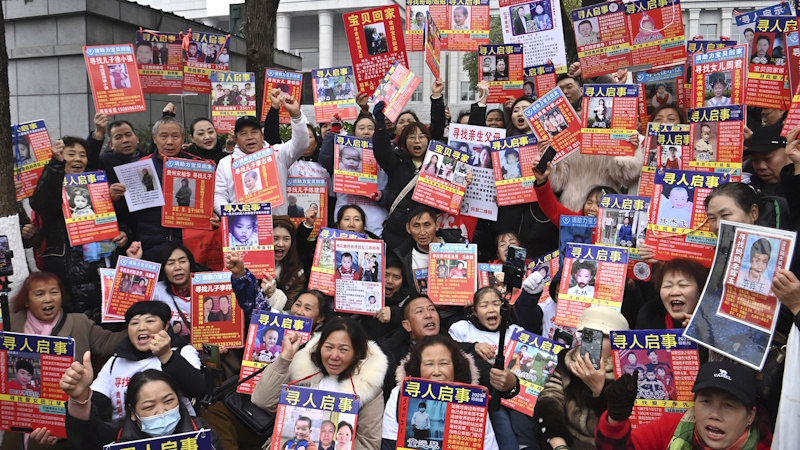

China calls itself socialist. To many Western observers, that word suggests a familiar package: free healthcare, free education, generous pensions, unemployment assistance and a government that takes care of its population. The assumption is that a communist country must do at least as much for ordinary people as Western welfare states.
That assumption confuses political branding with economic priorities. China has real social programs and has made considerable progress in living standards, but its system is a long way from the comprehensive welfare arrangements found in much of Europe. Its government has extraordinary powers to direct investment, finance industries and mobilize capital. Those powers do not automatically translate into generous household benefits.
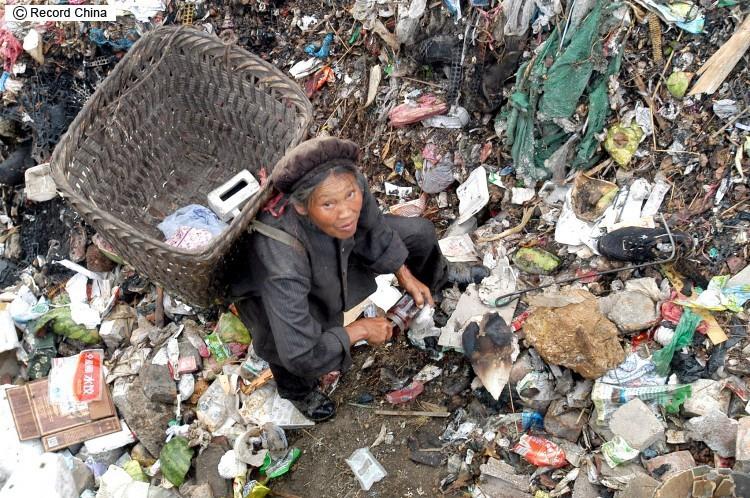
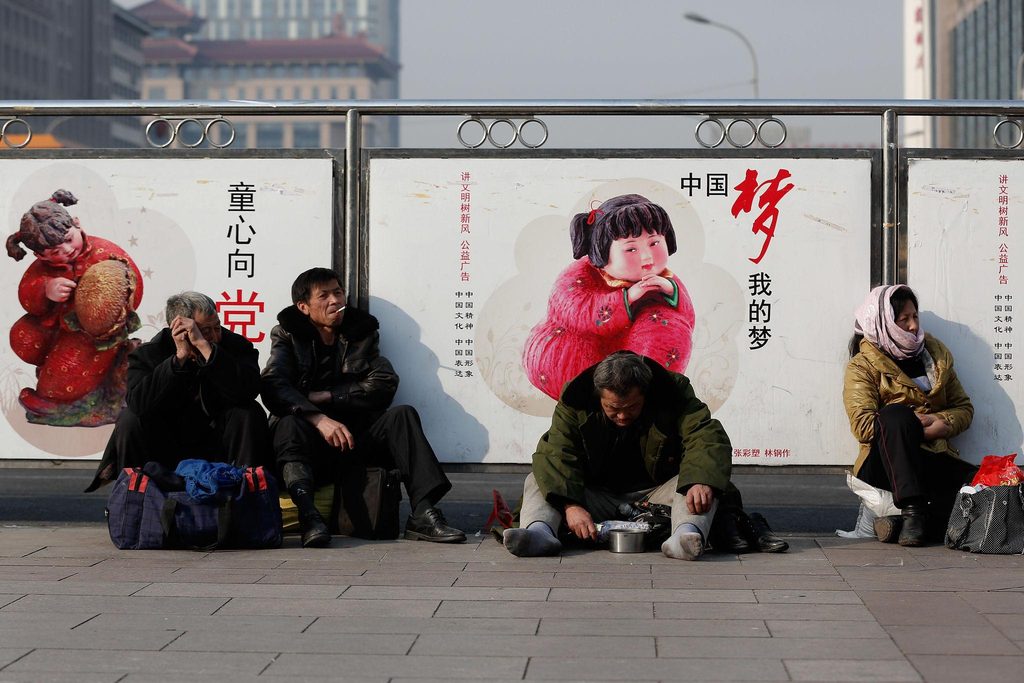
The photograph was reported to include a propaganda slogan referring to the Chinese Dream (中国梦). The juxtaposition became a subject of online criticism.
The China socialism myth deserves closer examination through a simple question: where does public money actually go, and how much financial protection does an ordinary household receive in return?
First, get the spending figures right
An important correction to the frequently circulated claim that China spends only 7.7% of its tax revenue on social programs: the figure actually corresponds to approximately 7.7% of GDP when combining education, social security and employment, and healthcare expenditure in 2024.
Those three broad categories amounted to approximately $1.57 trillion, equivalent to roughly 60% of tax receipts. This is substantial expenditure, so it would be misleading to claim that China spends only 7.7% of tax revenue on social programs.
The more interesting question is what those vast categories actually deliver. Broad expenditure figures include education, insurance schemes and other services. They tell us little about whether a rural pensioner can afford to live independently, whether an unemployed migrant worker qualifies for assistance, or whether a homeless person can obtain long-term accommodation.
For that, we need to look at individual benefits and the narrower social-assistance budget.
The elderly: a pension of around $24 a month
Perhaps the most revealing example of China’s welfare priorities is its resident pension system, which covers people outside the more generous formal employee pension arrangements. A large proportion of its beneficiaries are rural residents.
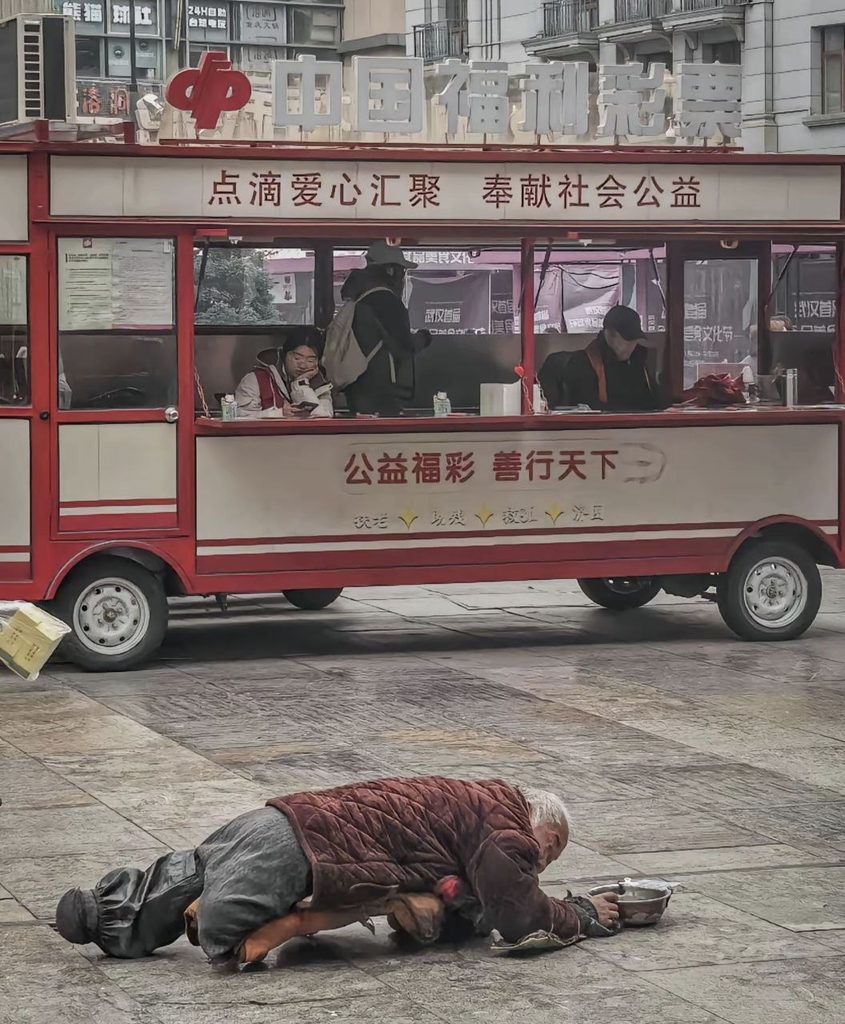
点滴爱心汇聚,奉献社会公益 — Every little act of love contributes to public welfare.
公益福彩,善行天下 — Public welfare lottery, goodness throughout the world.
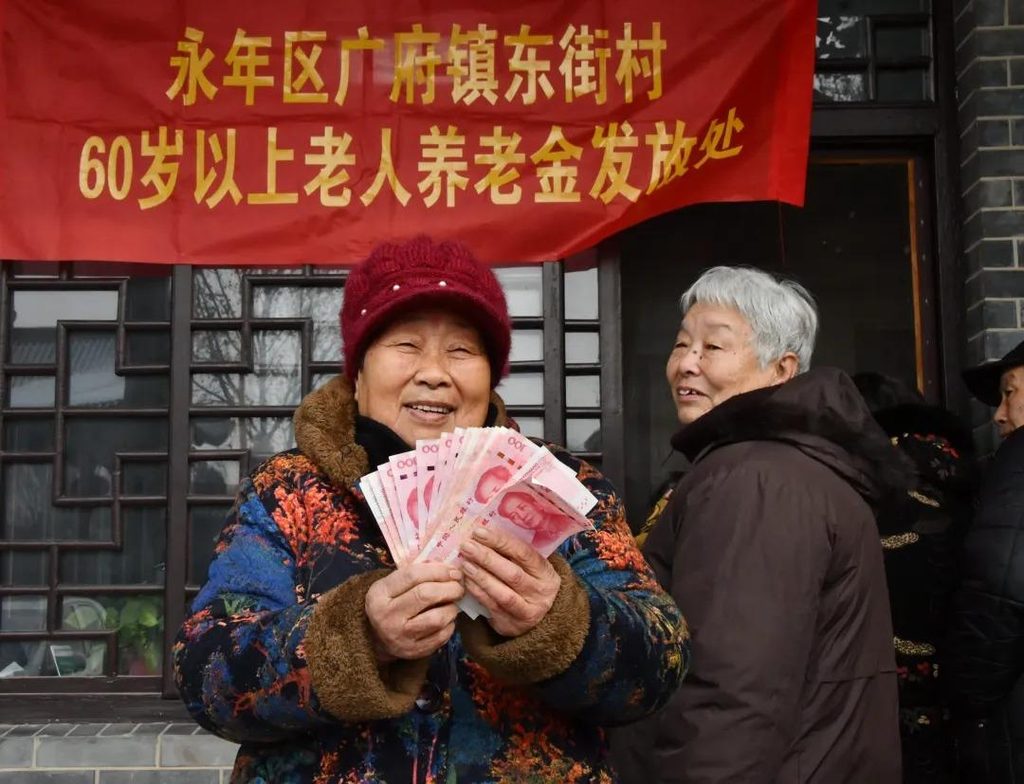
In March 2026, the national minimum basic resident pension was increased to approximately $24.40 per month. This is the basic government-funded component, with provincial additions and individual-account benefits varying by location and contributions.
The average figures for 2024 were only slightly higher:
- Government-funded basic resident pension: approximately $30 per month.
- Average total resident pension, including individual-account benefits: approximately $37.50 per month.
- Average basic employee pension: approximately $450 per month.
That is a fifteen-fold difference between the average basic benefits of the resident and employee schemes.
For perspective, average rural disposable income in 2024 was approximately $3,466 annually, or $289 per month per person. The average government-funded resident pension of $30 therefore represented only about 10% of average rural per-capita income.
The IMF’s February 2026 pension study reached a similar conclusion. China’s resident pension has broad coverage, but its non-contributory basic benefit amounts to only around 2% of average wages, among the lowest levels in its international comparisons.
The distinction matters. China has succeeded in enrolling hundreds of millions of people in pension arrangements. In 2024, the resident pension program had around 538 million participants, with approximately 180 million already receiving pensions. Coverage, however, does not make a $24 monthly minimum an adequate retirement income.
Sources: IMF, Population Aging and Pension Reforms in China, 2026 · Peterson Institute, Does a Weak Social Safety Net Hold Back Private Consumption in China? · SCMP, China’s rural pension debate, March 2026.
Social assistance: a surprisingly small budget
China’s means-tested minimum living allowance, known as Dibao, provides support to very low-income households. Another program, Tekun, assists people in particularly difficult circumstances, including those unable to support themselves.
These are genuine social programs, but their financial scale deserves attention.
A UNICEF China budget analysis published in August 2024 found that total social-assistance expenditure reached approximately $48.2 billion in 2022. Despite increasing in nominal terms, this spending fell from 1.65% to 1.24% of general public expenditure between 2012 and 2022. Its share of GDP declined from 0.39% to 0.27%.
The definition here matters: UNICEF’s calculation includes minimum living allowances, temporary assistance, support for people in extreme hardship, medical assistance and disaster relief. It does not include housing, education and unemployment assistance, which were not separately identifiable in the general public budget used for the analysis.
Dibao itself covered approximately 40 million people in 2024: around six million urban residents and 34 million rural residents. Average monthly benefits were approximately $120 per urban recipient and $90 per rural recipient. Total Dibao payments represented only around 0.1% of GDP.
The latest government figures, from the first half of 2026, reported approximately 44.29 million people receiving basic living assistance, including Dibao and assistance for people in extreme hardship. Average local subsistence-allowance standards were approximately $126 per month in urban areas and $94 in rural areas.
These are average local benefit standards, not universal flat payments. Actual assistance depends on assessed household income, assets and eligibility.
For a country capable of mobilizing enormous resources for industrial development, these numbers raise an uncomfortable question about how much financial responsibility the state actually assumes when citizens fall into hardship.
Sources: UNICEF, Social Assistance in China, August 2024 · China Ministry of Finance, 2026 fiscal policy report · Peterson Institute, 2025.
Unemployment insurance: coverage is another problem
Unemployment insurance provides another useful test of how far China’s welfare system protects ordinary workers.
At the end of 2024, approximately 246 million workers were covered by unemployment insurance, representing about half of the formal urban workforce.
At that same point, only 4.6 million unemployed workers were drawing benefits, compared with approximately 11 million officially registered unemployed urban workers. Around 9.1 million had received benefits at some point during the year.
Average monthly unemployment benefits were approximately $285, compared with an average monthly wage of approximately $1,499 in urban non-private employment.
This is inadequate in the recent epidemy of unpaid factory workers. They are told to keep their jobs and wait for the owners to gather funds for several months until a protest or shutdown occurs. We’ve seen several factories set on fire (every week in past years), since the legal system is not set up to protect worker’s either.
The comparison is not between identical populations, and eligibility depends on employment and insurance contributions. Nevertheless, it illustrates the limits of a scheme that reaches only part of the workforce and provides relatively modest replacement income.
Migrant and informal workers are particularly important here. A worker moving between locations or working outside formal employment arrangements can have much more difficulty accessing the same protections as a permanently employed urban resident.
Source: Peterson Institute, 2025.
Homelessness: temporary rescue instead of a permanent safety net
There is another revealing aspect of China’s social policy: how it deals with people who have nowhere to live.
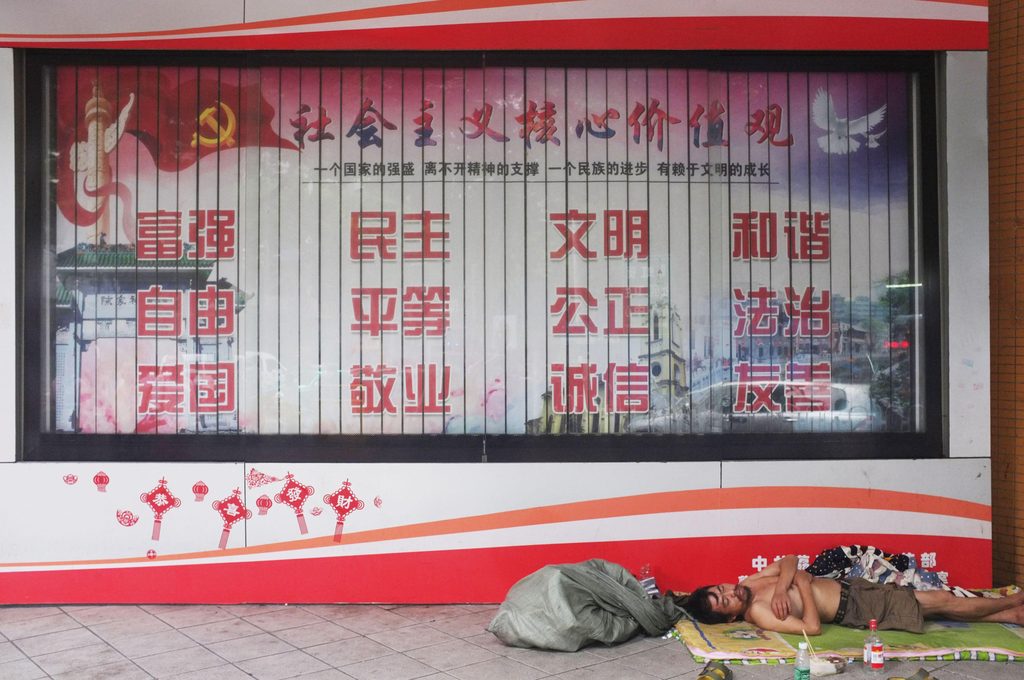
Translation: Prosperity, democracy, civility, harmony, freedom, equality, justice, rule of law, patriotism, dedication, integrity and friendship.
China does not publish a reliable nationwide count of homeless people in the conventional sense. A Chinese government report submitted to a UN committee explicitly acknowledged the lack of statistics on homelessness.
The system is based on rescue and temporary assistance stations. Under the State Council’s 2003 regulations, these facilities are required to provide basic food, temporary accommodation, emergency medical assistance and help contacting relatives. They can also provide transport for people who cannot afford to return to their place of residence or work.
The same regulations describe this explicitly as temporary social assistance. They encourage recipients to return to their previous place of residence or employment, and place responsibility for arranging support for homeless people with the government where their household registration, or hukou, is located.
The regulations also state that people must not be prevented from leaving the assistance station.
The distinction is important. The system offers emergency relief, but it does not create a general entitlement to permanent urban accommodation.
The historical figures are revealing. In 2012, 2,031 rescue agencies recorded approximately 2.77 million assistance encounters, with an average stay of only three to four days. These were assistance instances, not 2.77 million distinct homeless people.
There is no reason to treat this old figure as a current homelessness count. It does, however, illustrate the short-term nature of the model.
For people who have lost their income, have no family support or cannot return to their registered home, short-term rescue does not necessarily resolve the underlying housing problem.
Sources: China’s 2003 Regulations on Assistance for Urban Vagrants and Beggars · Chinese government report to the UN committee.
Myth: China abolished poverty
China’s announcement that it had eliminated extreme poverty in 2020 is frequently presented as proof of the success of its socialist model.
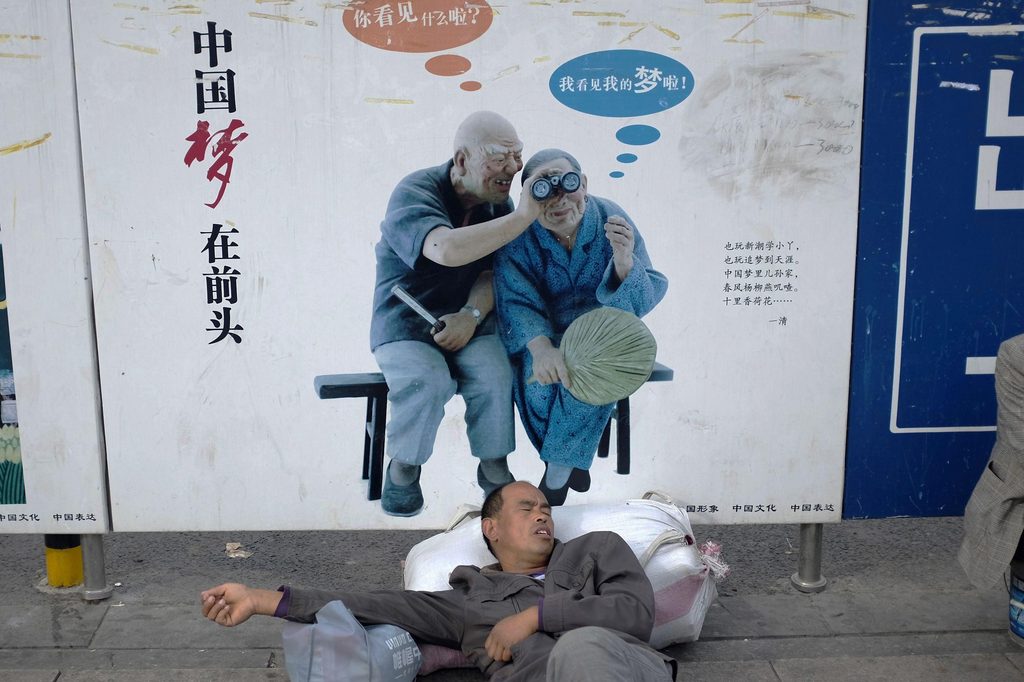
There was real progress. The government reported lifting approximately 98.99 million rural residents out of poverty between 2012 and 2020.
But the poverty threshold used to measure that achievement deserves scrutiny.
China’s official rural poverty standard was established at approximately $333 per person per year in 2010 prices. Following price adjustments, the National Bureau of Statistics confirmed that the threshold had reached approximately $499 per person per year in 2020, equivalent to just $1.37 per day at the average 2020 exchange rate.
More importantly, this was exclusively a rural poverty measure. The Chinese National Bureau of Statistics explicitly clarified that its historical poverty counts referred to rural residents, not the entire Chinese population.
The poverty exit criteria also included the government’s Two Assurances and Three Guarantees: adequate food and clothing, access to compulsory education, basic medical care and safe housing. These were meaningful objectives, but they did not establish a standard of living comparable to that of developed welfare states.
The World Bank’s October 2026 Poverty and Equity Brief provides another perspective. Using its $8.30-per-person-per-day upper-middle-income poverty benchmark, expressed in 2021 purchasing-power-parity dollars, it estimated that 21.3% of China’s population remained below that level in 2022.
That represented approximately 300 million people.
The distinction between the two poverty measures is essential. The World Bank’s $8.30 benchmark is a purchasing-power comparison, not $8.30 converted at the ordinary exchange rate. The $1.37 figure above is a historical nominal-dollar conversion. They cannot be directly compared as identical cash amounts.
Nevertheless, the broader conclusion is clear: eliminating extreme poverty under a narrowly defined rural threshold does not mean eliminating poverty or material hardship.
Sources: China’s National Bureau of Statistics, poverty threshold clarification · Federal Reserve, 2020 exchange rates · World Bank, Poverty and Equity Brief, October 2026.
Myth: 99% of Chinese people own their homes
The often-repeated claim that virtually every Chinese person owns a home also needs clarification.
China genuinely has high homeownership rates. According to the 2010 census data examined by the World Bank, national homeownership stood at 85.4%, with a significant difference between urban and rural residents: 74.9% in urban areas and 96.3% in rural areas.
A 2019 People’s Bank of China survey involving 31,000 urban households found that 96% of respondents already owned at least one house. Many owned multiple properties.
This is where the popular statistic gets misleading. It is a household-level survey result, not evidence that 99% of individual Chinese citizens each hold ownership of a property. Nor does it establish that every property owner owns the land beneath their home.
In mainland China, individuals cannot own land outright as private freehold property.
Article 10 of China’s Constitution is explicit:
- Land in urban areas belongs to the State.
- Land in rural and suburban areas belongs to collectives, except for land legally designated as State-owned.
People can privately own residential buildings and apartments, but the underlying land remains state-owned or collectively owned.
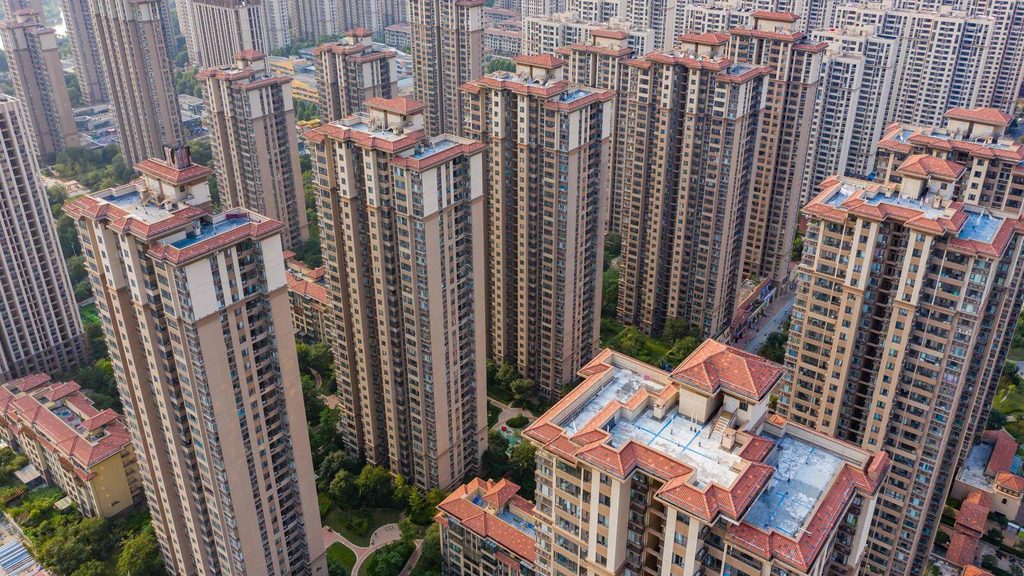
Urban residential properties are generally associated with land-use rights granted for a maximum of 70 years. These rights can be transferred along with the property. Article 359 of China’s Civil Code also provides for automatic renewal when residential land-use rights expire, with the treatment of renewal fees governed by relevant laws and regulations.
This is an important distinction: owning an apartment is a real and legally protected property right, but it is not the same thing as owning the underlying land outright.
In rural areas, families can own their houses while their homestead land remains collectively owned, with individual households holding rights of use.
Consequently, China’s high homeownership statistics cannot be used as evidence that nearly all citizens possess full private land ownership. Housing ownership, land ownership and the rights attached to a property are three different things.
Sources: World Bank, China Economic Update, June 2022 · Constitution of the People’s Republic of China, Article 10 · Civil Code, Article 359.
Meanwhile, industrial policy receives enormous resources
The contrast becomes clearer when looking at the state’s relationship with business.
An IMF working paper published in August 2025 estimated that the fiscal-equivalent cost of Chinese industrial policy reached approximately 4.4% of GDP in 2023.
Researchers estimated the equivalent cost of cash subsidies at 2% of GDP, tax advantages at 1.5%, subsidized land at 0.5% and subsidized credit at 0.4%.
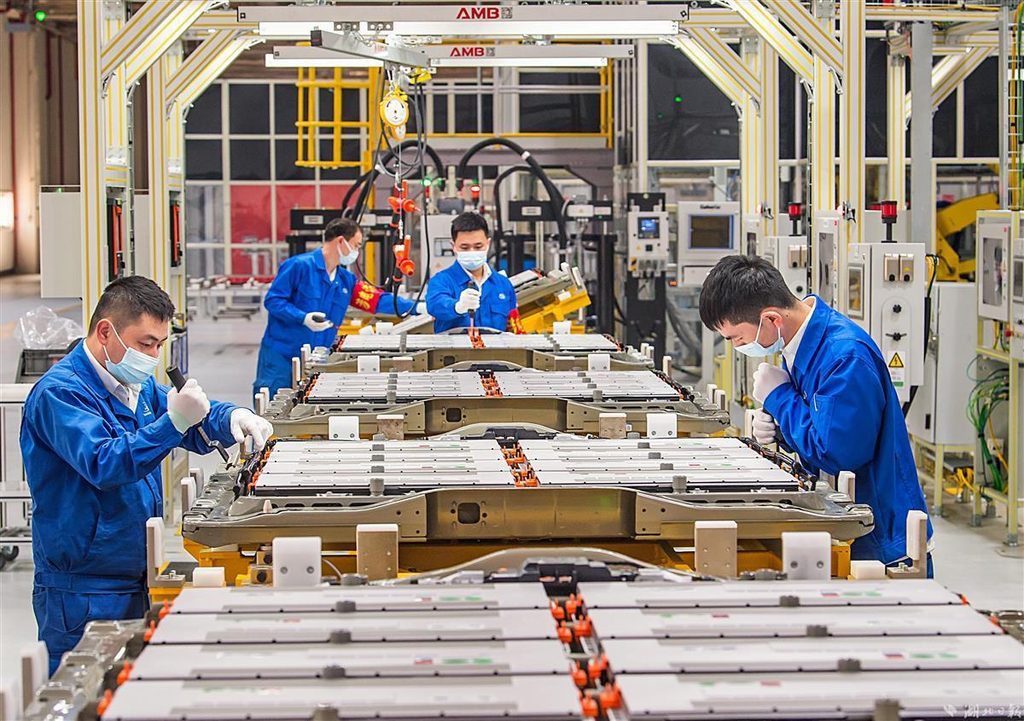
These estimates cover more than direct government grants and include forms of assistance to both private and state-owned enterprises. They are not simply transfers recorded in the national budget.
The beneficiaries include priority manufacturing and technology sectors such as electric vehicles, batteries and semiconductors. The government’s ambition is to develop domestic industrial capabilities, reduce dependence on foreign suppliers and strengthen Chinese companies in international markets.
There are legitimate reasons for developing strategic industries. The problem is assuming that government support automatically creates economic value. The IMF research identified capital misallocation and excess capacity as consequences of poorly targeted industrial support, estimating an aggregate productivity loss of approximately 1.2%.
Producing more goods is not automatically the same as producing more wealth. A subsidized company can expand capacity even when demand cannot absorb its output profitably.
Industrial subsidies and household welfare also serve different purposes. A company receiving cheap financing does not necessarily create stronger pensions, more affordable housing or greater financial security for its employees.
Source: IMF, Industrial Policy in China: Quantification and Impact on Misallocation, 2025.
The real priorities behind China’s socialism myth
China is not a country without healthcare, education, pensions or social assistance. It has expanded access to many services, reduced extreme rural poverty and built insurance systems covering enormous numbers of people.
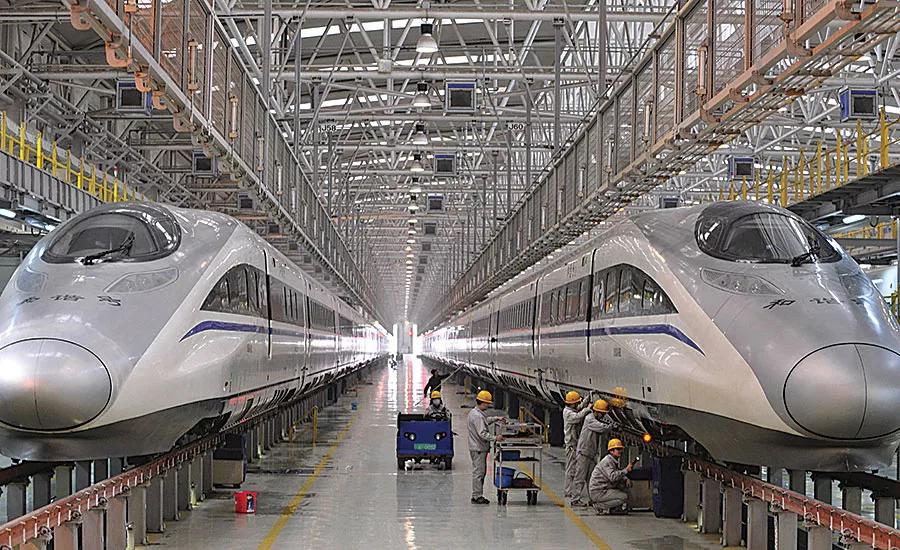
But coverage and generosity are separate measures. A country can enroll hundreds of millions of people in pension programs while providing some of them with only a few dollars a day. It can establish emergency shelters without guaranteeing long-term accommodation. It can report the elimination of extreme poverty while hundreds of millions remain below a substantially higher living-standard benchmark.
The same government can mobilize enormous resources to develop industrial champions and strategically important infrastructure (although they can fail) while maintaining modest benefits for people outside formal employment.
The most revealing part of China’s socialist model is therefore the gap between the power of the state and the security of the individual.
China has demonstrated an extraordinary ability to mobilize capital for industrial development. The evidence on pensions, social assistance, unemployment protection and homelessness shows that this ability has not translated into equally strong financial protection for ordinary households.
The Chinese government may call this socialism. Understanding what that means in practice requires looking beyond the label and examining what citizens actually receive. And long term this didn’t seem to be a sustainable model. The great firewall and language barrier protects China’s true image.
useful sources:
- IMF 2026 pension study — rural pension adequacy and international comparisons.
- UNICEF social-assistance budget analysis — the decline in social assistance as a share of public expenditure.
- World Bank October 2026 poverty report — poverty measured against a higher living-standard benchmark.
- China’s actual homelessness assistance regulations — temporary accommodation, return assistance and responsibility under hukou.
- World Bank homeownership analysis — the actual urban/rural percentages and the 96% survey.