

Artificial intelligence is increasingly being credited with transforming workplace productivity. Technology companies promise dramatically faster development, executives are reorganizing entire departments around AI, and employees are being evaluated on how extensively they use these tools. Yet an increasingly important question is emerging: Are companies actually completing more work, or simply producing more AI-generated activity?
Spoiler alert: They failed making an actual AI, so they’re satisfied making their LLMs cause Idiocracy. Okay, this is my personal views. But really, all the research I gathered on the topic points to this crashout.
A new Harvard research paper provides an unusually detailed look at that question. By examining hundreds of millions of workplace records across hundreds of software companies, researchers have identified a substantial gap between the amount of work AI helps generate and the amount of completed software that reaches production.
The findings do not suggest that AI coding tools are ineffective. They show that faster code generation does not automatically translate into faster business operations, greater output, or fewer employees. The additional work still has to pass through planning, review, testing, approval and deployment.
1. The Harvard study: Measuring what companies actually produce
The research, titled Artificial Intelligence in the Firm: Bottlenecks in Software Production, was conducted by Fiona Chen and James Stratton of Harvard University.
The latest version, dated November 14, 2026, examines:
- 655 companies.
- 720,542 workers.
- Approximately 445 million workplace events.
- Data covering January 2021 through August 2026.
The researchers obtained anonymized information from Jellyfish, an engineering analytics platform that integrates GitHub, Jira, Google Calendar and AI-tool usage data. This allowed them to follow software development from the initial coding activity through review and eventual completion of projects.
The researchers distinguish between two generations of AI software tools.
AI assistants provide suggestions and code completions while a developer works. GitHub Copilot and earlier Cursor functionality are examples.
AI agents can undertake more extensive assignments, plan multiple steps and generate or modify substantial amounts of code with less continuous human intervention. Claude Code and agentic Cursor functionality are examples.
This distinction matters because the measured effects differ considerably.
The increase in coding activity
Twelve months after adoption, researchers estimated the following changes in activity per worker:
| Measurement | AI assistants | AI agents |
|---|---|---|
| Lines of code added | +30.4% | +44.0% |
| Commits | +16.8% | +36.0% |
| Pull requests opened | +20.9% | +35.7% |
A commit records a saved change to a codebase. A pull request submits a proposed collection of changes for review before integration.
The increases in commits and pull requests were statistically significant. The larger estimates for lines of code were less statistically conclusive.
One important detail: companies adopting agents frequently already had AI assistants. The agent figures therefore reflect the additional effects associated with that newer generation of tools, rather than two completely independent groups of companies.
These measurements demonstrate that AI is substantially increasing software development activity. They do not establish that companies are delivering finished software at the same rate.
2. More code does not automatically mean more completed software
The Harvard researchers went beyond counting generated code. They examined Jira records to determine whether the additional coding activity resulted in more completed software tasks and larger projects.

The findings were considerably less dramatic.
Following adoption of AI agents, the estimated changes were:
| Completed work measurement | Estimated change |
|---|---|
| Jira issues resolved | +13.7% |
| Jira epics resolved | +18.0% |
An issue represents an individual software task, while an epic tracks the completion of a larger feature or project.
Both estimates were positive, but neither was statistically conclusive. The researchers could not establish that these increases were reliably different from zero.
They also examined whether companies were simply changing the size of their Jira tasks to make productivity appear different. Using machine-learning methods to estimate task complexity, they found no evidence of a significant change in average task size.
The difference between the coding and completion measurements is central to the research.
Companies were generating substantially more code and opening more pull requests, but the corresponding increase in completed software was much smaller and statistically uncertain.
This is particularly important when evaluating AI productivity. Lines of code, generated documents and completed prompts are intermediate measurements. Businesses ultimately need functioning products, completed projects and deliverables that satisfy their requirements.
3. Code review has become a major bottleneck
The researchers investigated where the additional coding activity was going.
One of their most significant findings concerns the software review process.
AI agents increased coding activity, but the additional code still required other engineers to inspect it, identify mistakes, request modifications and approve changes.
Following adoption of AI agents, the time between submitting a pull request and its eventual approval increased by approximately 1.99 days.
That represents a 56.1% increase, against a baseline average of 3.56 days.
The researchers also separated the time spent waiting for someone to begin reviewing the work from the time spent actively reviewing it.

Both increased:
- Time waiting in the review backlog: approximately 1.67 additional days.
- Time spent in active review: approximately 2.33 additional days.
The number of comments per pull request increased by approximately 38.6%.
The researchers did not find a significant increase in pull-request size, suggesting that the additional review activity cannot simply be explained by developers submitting substantially larger changes.
Importantly, not every review-related measurement was statistically conclusive. The estimated increase in formally blocked pull requests and in the proportion receiving comments was marginally insignificant. The strongest findings concern the additional time required to get code through review and the increase in comments per request.
AI still needs human supervision
Companies are already experimenting with AI-assisted code review.
By July 2026, 79.1% of the firms in the study had used AI tools in their review process. Nevertheless, only 23.3% of review comments were generated by AI, and only 10.8% of pull requests received at least one AI-generated review comment.
Human reviewers therefore remain heavily involved.
There is another practical constraint: reviewers need familiarity with the software they are inspecting. The study found that 82.8% of reviews were conducted by people who had previously contributed to the same codebase.
Moving additional employees into code review is therefore not as simple as assigning anyone available to check the work.
The researchers also conducted qualitative interviews with 21 software-industry workers. Several described a shift in their responsibilities from writing code towards inspecting, correcting and validating AI-generated changes.
For routine work, AI can produce useful drafts extremely quickly. More complex engineering assignments still require considerable human judgment and correction.
4. Where does the time saved actually go?
The study makes another interesting observation about the organization of software engineering.
Researchers estimated, using workplace records and additional surveys, that engineers spend approximately 30–40% of their working time writing code.
The remaining time involves complementary activities such as planning, communication, testing, reviewing, coordinating and managing projects.
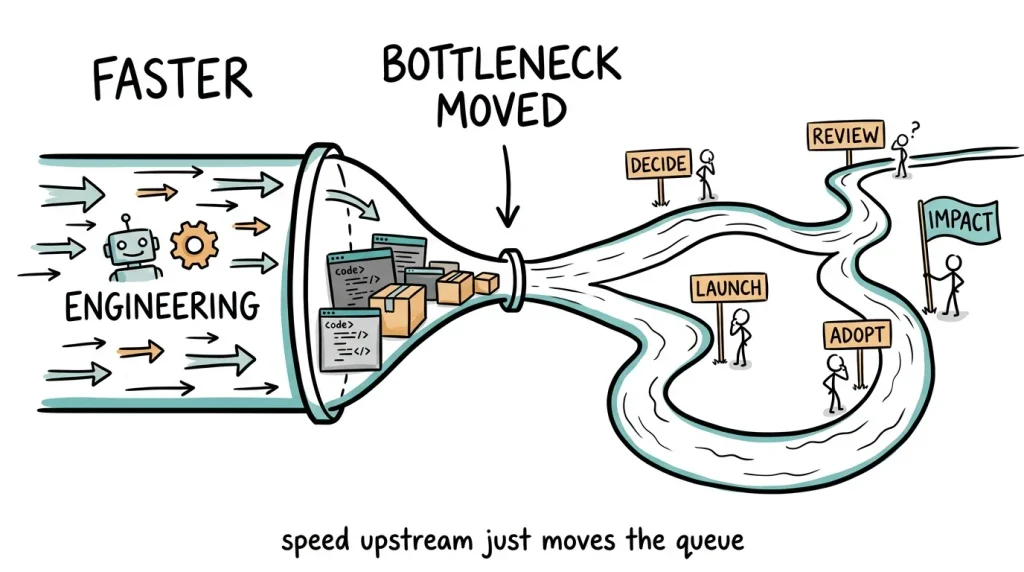
This explains why substantial improvements in coding speed do not necessarily produce equivalent improvements in overall productivity.
An engineer might generate a feature in an hour instead of a day. The feature must still be checked against requirements, tested, approved and integrated with the rest of the application.
The bottleneck simply moves further along the production process.
In some organizations, the additional volume of AI-generated work actually increases the workload of senior engineers responsible for approving it.
The same principle applies outside software development. Faster document generation does little to accelerate an organization when legal approval, management decisions, customer communication or regulatory procedures remain unchanged.
The technology can accelerate one stage without eliminating the constraints imposed by the rest of the organization.
5. What about employment and AI-related layoffs?
The Harvard researchers also examined whether companies were reducing their workforce after adopting AI coding tools.
They found no statistically significant changes in engineering employment attributable to the adoption of either AI assistants or AI agents.
They also examined total company employment using LinkedIn records, separating junior and senior employees and examining hiring and departures.
The results did not establish an attributable reduction in overall employment or a decline in junior hiring.
However, these findings require qualification. The study examines relatively short periods after adoption, generally 12–16 months. Its authors explicitly acknowledge that employment adjustments can take longer and that their company-level analysis cannot capture all indirect effects across the wider economy.
There is also an important difference between companies announcing layoffs in the name of AI and research demonstrating that AI actually replaced the affected employees.
Consider two recent examples:
Netflix: In October 2026, the company announced approximately 1,000 job cuts, representing around 6% of its workforce. Its executives described the decision as a matter of prioritizing resources and making focused business choices. The announcement itself did not establish that AI had directly replaced those employees.
Microsoft: In October 2026, Microsoft introduced another voluntary exit program, with approximately 60,000 employees eligible to participate. That figure represents potential eligibility, not 60,000 confirmed job losses.
Companies can simultaneously increase AI investment, reorganize departments, offshore operations and reduce staffing. Establishing which factor actually caused a particular job loss requires more than repeating an executive’s reference to AI.
Recent reporting from Australia has also highlighted accusations of AI washing, where organizations invoke AI when explaining workforce reductions that may also involve outsourcing and conventional cost-cutting.
The distinction between technological capability and actual workforce displacement remains important.
What does Harvard predict for the future?
Although the study finds no detectable short-term employment reduction, its authors also construct an economic model to explore longer-term possibilities.
The model considers what could happen if companies reorganize their workforce and AI capabilities continue improving.

Two scenarios illustrate the possible outcomes by 2031:
| Scenario | Projected employment change | Projected output change |
|---|---|---|
| Coding improves, review productivity remains constrained | -10.3% | +57.8% |
| AI improves review productivity as quickly as coding | -76.2% | +341.4% |
These are model-generated scenarios, not measured employment outcomes or guaranteed predictions.
The second scenario is explicitly described by the researchers as an upper bound. Their model simplifies software production into two principal activities: writing and reviewing code. It does not fully incorporate additional constraints such as requirements gathering, testing and customer coordination.
Nevertheless, the projections illustrate why the researchers do not interpret today’s limited employment effects as proof that AI will have no future impact on staffing.
6. Other research: Why measured productivity and perceived productivity disagree
The Harvard research is not the only attempt to measure AI’s effect on professional work.
Another frequently discussed experiment was conducted by METR (Model Evaluation & Threat Research), which examined experienced open-source software developers.
In its July 2025 randomized controlled trial, researchers asked 16 experienced developers to complete 246 tasks in software projects they already knew well.
Each task was randomly assigned to allow or prohibit AI assistance.
The results were surprising:
- Developers initially expected AI to reduce completion times by 24%.
- After the experiment, they believed AI had made them approximately 20% faster.
- Measured completion times actually increased by 19%.
The study used early-2025 tools, primarily Cursor Pro and Claude 3.5/3.7 Sonnet. Its findings therefore should not be treated as a measurement of every subsequent generation of AI coding agents.
There is also an important statistical qualification: the estimated slowdown had a confidence interval of approximately 2–39%. The experiment provides evidence of a slowdown in that particular setting, rather than proof that AI universally makes programmers slower.
The follow-up exposed a different problem
METR attempted a larger follow-up experiment beginning in August 2025.
It included 10 developers from the original study and 47 new participants recruited from a broader range of open-source projects.
However, the researchers encountered a serious sampling problem. Increasing numbers of developers were unwilling to participate in tasks where AI was prohibited, even when offered $50 per hour.
Other problems included the lower participant payment compared with the original experiment and difficulties reliably measuring time when developers were running multiple AI agents simultaneously.
METR consequently concluded in February 2026 that the new experiment could not provide a reliable estimate of AI productivity.
The available results suggested some speedup, but the researchers warned that the strongest AI users and those most dependent on the tools were increasingly absent from the experiment.
This is a useful illustration of why measuring AI productivity has become difficult: the technology is changing the behavior of the very people researchers need to study.
Not all studies find disappointing results
There is also positive experimental evidence.
A June 2025 study by researchers associated with Princeton, MIT, Microsoft and other institutions combined three field experiments involving 4,867 software developers at Microsoft, Accenture and an unnamed Fortune 100 company.
Developers given access to AI code-completion assistance completed approximately 26.1% more tasks in the pooled analysis.
Less experienced developers generally experienced larger productivity gains.
Another study published in the Quarterly Journal of Economics examined 5,172 customer-support agents using a generative AI conversational assistant.
It found an average productivity improvement of approximately 15%, measured by issues resolved per hour. The greatest gains were concentrated among less experienced and lower-skilled employees.
These results demonstrate that AI can deliver measurable productivity improvements, particularly in structured workflows where tasks are relatively well-defined.
They also demonstrate why findings from one profession cannot automatically be transferred to another.
7. The famous MIT claim about 95% of AI pilots failing
The Harvard research is consistent with another widely discussed investigation into enterprise AI adoption.
The July 2025 MIT NANDA report, The GenAI Divide: State of AI in Business 2025, claimed that 95% of organizations in its research sample were getting no measurable financial return from generative AI investments.
The figure has frequently been repeated as a claim that 95% of corporate AI pilots fail.
That description simplifies the original findings.
The report used three research methods:
- Review of more than 300 publicly disclosed AI initiatives.
- Structured interviews with representatives of 52 organizations.
- Survey responses from 153 senior leaders.
Its findings distinguished between general-purpose tools such as ChatGPT and Copilot, and custom enterprise AI systems designed for specific business workflows.
More than 80% of organizations had explored or piloted general-purpose tools, and nearly 40% reported deployment.
Custom enterprise systems experienced considerably more difficulty. According to the report, approximately 60% of organizations evaluated these systems, 20% reached the pilot stage and only 5% reached production.
The authors identified problems including poor integration with existing systems, insufficient organizational context and difficulty adapting tools to actual business processes.
The report also acknowledges important methodological limitations, including possible selection bias, inconsistent definitions of success and a relatively short six-month period for assessing financial returns.
It should therefore be understood as evidence of difficulties translating enterprise AI investment into measurable business results, rather than a definitive failure rate for the entire AI industry.
8. Similar problems in healthcare, law and professional services
Software development is particularly useful for examining AI productivity because much of its activity leaves measurable digital records. However, similar questions are appearing in other professional fields.
Healthcare documentation
AI scribes are designed to listen to medical consultations and automatically generate structured clinical notes.
A large 2026 multisite study published in JAMA examined 8,581 clinicians across five American academic medical centers, including 1,809 AI-scribe adopters.
Researchers found that adoption was associated with:
- 13.4 fewer minutes of total electronic health record time per eight scheduled hours of patient care.
- 16 fewer minutes spent on documentation.
- Approximately 0.49 additional patient visits per clinician per week.
Time spent on electronic records outside scheduled working hours did not change significantly.
These are encouraging results, although the authors describe the benefits as modest and acknowledge differences between clinician groups.
A separate, smaller simulation study published in JAMIA Open examined nine primary-care physicians conducting simulated consultations.
It found that documentation time declined from 36.3% to 11.2% of the simulated consultation when using an AI scribe.
However, post-conversation processing time increased from 16.2% to 23.2% of the encounter. This difference was not statistically significant at the conventional 5% threshold.
These two studies should not be confused: the larger JAMA study found modest real-world administrative improvements, while the smaller simulation highlighted the additional time that can be spent reviewing and completing AI-generated documentation.
Legal research and fabricated citations
Legal work provides another example of the importance of verification.
Courts have repeatedly encountered legal documents containing fabricated case citations, incorrect quotations and misrepresented legal authorities generated or assisted by AI systems.
On November 16, 2026, Reuters reported that a Delaware lawyer had been fined $2,500 after submitting a brief containing flawed citations and mischaracterized legal authorities following the use of Perplexity Enterprise.
Earlier in 2026, the US Court of Appeals for the Tenth Circuit imposed a $1,000 sanction on an attorney whose AI-assisted brief contained nonexistent cases.
The problem is not limited to individual lawyers.
In Australia, Deloitte’s government-commissioned report on the Targeted Compliance Framework contained incorrect references and a fabricated quotation attributed to a federal court judge. Official government correspondence indicated that generative AI tools used in summarizing a legal case and processing citations likely contributed to the errors.
The department requested repayment of the final contract instalment of AUD 97,587.11.
These incidents demonstrate that generating a professional-looking document is not equivalent to producing a verified professional deliverable. Someone still has to establish that the underlying information is correct.
9. The Amazon outage: Separating the incidents
The March 2026 Amazon website disruptions have also been used as an example of the risks associated with AI-assisted engineering.
However, the incidents need to be distinguished.
On March 2, an incident involving Amazon’s Q AI tool contributed to incorrect delivery estimates, according to internal documents reported by Business Insider. The incident reportedly resulted in approximately 120,000 lost orders and 1.6 million website errors.
On March 5, a separate production incident caused a major disruption to Amazon’s shopping services. Internal documents reported approximately 6.3 million lost orders.
Amazon subsequently disputed media reports suggesting that AI-written code had caused its outages. In its March 11 statement, the company said only one of the incidents involved AI-assisted tooling, that none involved AI-written code, and that the relevant incident involved an engineer following inaccurate advice derived from an outdated internal wiki.
The distinction matters. It would be inaccurate to attribute the entire March outage and the reported 6.3 million lost orders to AI-generated code.
Nevertheless, the incidents prompted renewed attention to software deployment controls, approvals, validation and the potential consequences of relying on inaccurate AI-assisted recommendations.
The general operational issue remains relevant: generating changes faster does not remove the need to validate their consequences before deployment.
10. The actual measure of AI productivity
The evidence points towards a more complicated picture than either the enthusiastic predictions of technology companies or the claim that AI has failed to deliver meaningful benefits.
AI can substantially accelerate particular activities. Software generation, document preparation, information retrieval and routine customer support can all benefit from automation.
The economic result depends on what happens after those activities are accelerated.
The Harvard study demonstrates this particularly clearly. Companies adopted increasingly capable coding agents and generated much more code, yet the additional activity encountered constraints in review, deployment and completion.
The same underlying problem can occur in other professions. A medical note still needs checking, legal research still needs verification, and business decisions still require people with sufficient knowledge and authority to approve them.
For companies evaluating AI investments, the important measurements are therefore larger than the volume of generated content.
They include:
- Completed and deployed work.
- Time required for verification and correction.
- Quality and reliability of the final result.
- Total cost of implementation, subscriptions and additional supervision.
- Actual changes in business output, customer service and staffing requirements.
The latest Harvard research does not establish that AI productivity gains are imaginary. It shows that measuring productivity at the point where AI generates work can dramatically overstate the benefits achieved by the organization as a whole.
Sam Altman, 2024: “I have no idea how we may one day generate revenue. We have made a soft promise to investors that once we’ve built this sort of generally intelligent system, basically, we will ask it to figure out a way to generate an investment return for you. It sounds like an episode of Silicon
Valley. It really does. I get it, you can laugh. It’s all right. But it is what I actually believe is going to happen.”

Sources and further reading
Harvard research and software engineering
- Chen & Stratton — Artificial Intelligence in the Firm: Bottlenecks in Software Production. Latest version, November 14, 2026.
https://fion.ac/jellyfish.pdf - METR — Measuring the Impact of Early-2025 AI on Experienced Open-Source Developer Productivity.
https://metr.org/Early_2025_AI_Experienced_OS_Devs_Study-paper.pdf - METR — We are Changing our Developer Productivity Experiment Design, February 24, 2026.
https://metr.org/blog/2026-02-24-uplift-update/ - Cui, Demirer et al. — The Effects of Generative AI on High-Skilled Work: Evidence from Three Field Experiments with Software Developers.
https://www.mertdemirer.com/Papers/Demirer_AI_productivity.pdf - Brynjolfsson, Li & Raymond — Generative AI at Work. Quarterly Journal of Economics, 2025.
https://doi.org/10.1093/qje/qjae044
Enterprise adoption and financial results
- MIT NANDA — The GenAI Divide: State of AI in Business 2025.
https://mirro.ai/wp-content/uploads/2026/01/MIT_v0.1_State_of_AI_in_Business_2025_Report.pdf
Healthcare
- Rotenstein et al. — Changes in Clinician Time Expenditure and Visit Quantity With Adoption of Artificial Intelligence-Powered Scribes. JAMA, 2026.
https://jamanetwork.com/journals/jama/fullarticle/2847319 - Evaluating the Impact of Artificial Intelligence Scribes on Clinical Documentation in Primary Care: A Simulation Study. JAMIA Open, 2026.
https://doi.org/10.1093/jamiaopen/ooag101
Legal and professional accountability
- Australian Department of Finance — Deloitte correspondence concerning the Targeted Compliance Framework report and its erroneous references.
https://www.finance.gov.au/sites/default/files/foi-25-26-084-document-1.pdf - Reuters — Delaware lawyer sanctioned over AI-assisted legal filing, November 16, 2026.
https://www.reuters.com/legal/litigation/delaware-lawyer-sanctioned-over-ai-misuse-law-firm-escapes-punishment-2026-11-16/
AI-related workplace changes and operational incidents
- Amazon — Official clarification concerning media reporting about its March 2026 service incidents.
https://www.aboutamazon.com/news/company-news/amazon-outage-ai-financial-times-correction - Business Insider — Amazon tightens code controls following March 2026 operational incidents.
https://www.businessinsider.com/amazon-tightens-code-controls-after-outages-including-one-ai-2026-3 - Reuters — Australian companies face AI-washing claims following job cuts and offshoring, November 11, 2026.
https://www.reuters.com/business/world-at-work/australian-companies-face-ai-washing-claims-after-wave-job-cuts-offshoring-2026-11-11/ - Reuters — Netflix workforce reductions, October 14, 2026.
https://www.reuters.com/business/world-at-work/netflix-cuts-about-6-jobs-wsj-reports-2026-10-14/