
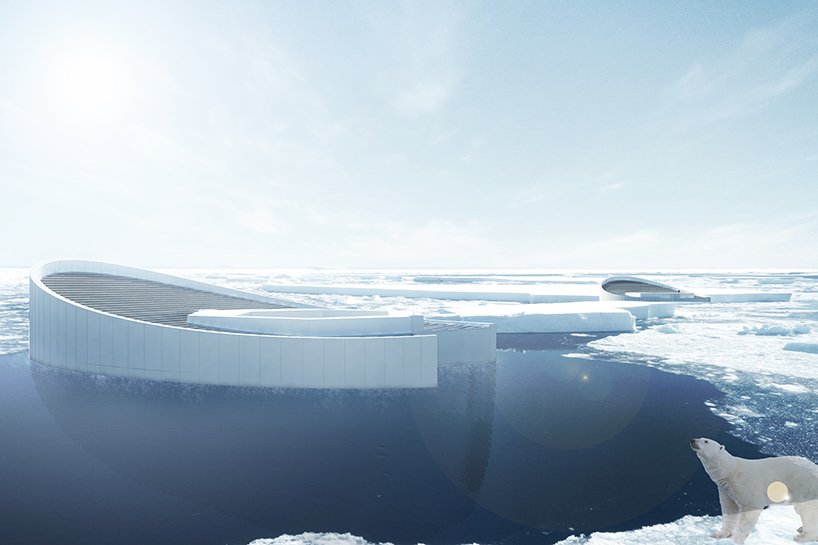
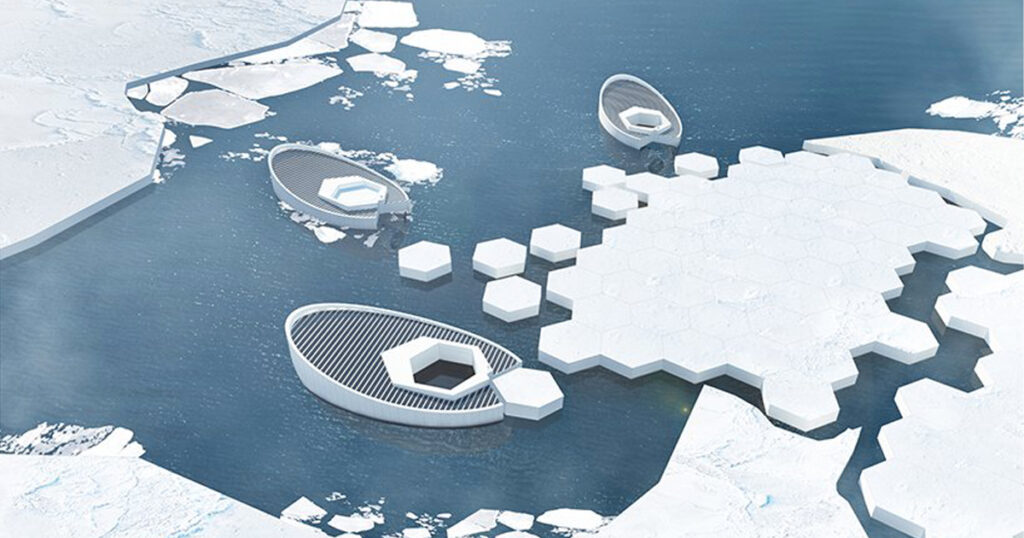
In 2019 a team led by 29-year-old Indonesian architect Faris Rajak Kotahatuhaha proposed a fleet of submarines that would manufacture hexagonal icebergs—“ice babies”—to refreeze the Arctic. The vessel submerges, fills a central hexagonal cavity with seawater, desalinates it to raise the freezing point by more than 3 °F, covers the chamber against sunlight, and after roughly a month ejects a 16-foot-thick, 82-foot-wide ice block. The hexagons are meant to interlock into larger ice sheets. The concept took second place in the Association of Siamese Architects International Design Competition for radical sustainability ideas and was widely covered by CNN, Forbes, Dezeen and others.
Philip E. Mason (Thunderf00t), the British chemist who has spent years testing over-hyped engineering claims, subjects the design to basic physics.
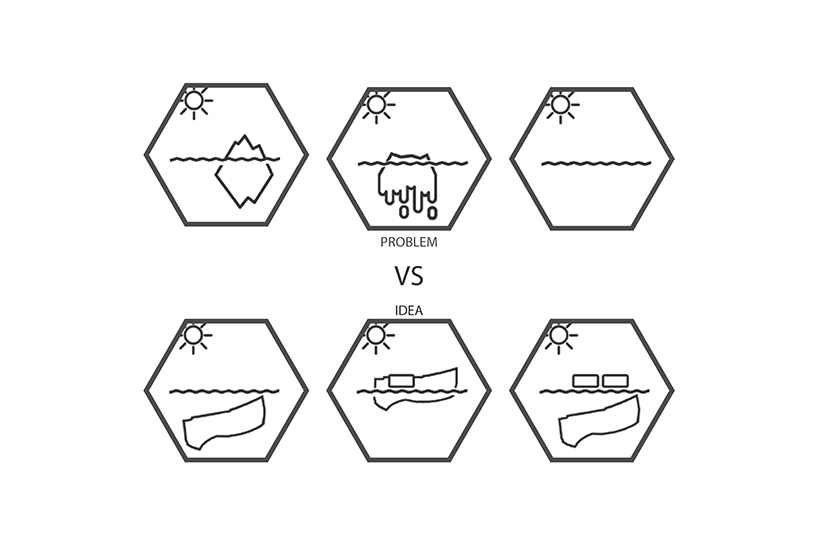
Ice has a density of about 0.917 g cm⁻³. Roughly 90 % of any floating iceberg therefore sits underwater. The promotional renders and schematics show the hexagonal blocks floating almost entirely above the surface, as if they were Styrofoam. Kitchen-scale blocks cut to the same proportions refuse to float that way; they tip or sit mostly submerged. The drawings simply ignore buoyancy.
Energy arithmetic is equally unforgiving. Industrial ice makers consume roughly 90 kWh per tonne. At even optimistic solar prices the energy cost alone is about $10 per tonne—$10 billion per gigatonne. Annual Arctic ice loss is on the order of a teratonne, so the energy bill to replace it would approach $10 trillion, half the annual U.S. GDP. Desalinating the water first adds cost for almost no gain: freezing itself already rejects much of the salt, and the latent heat of fusion (≈334 kJ kg⁻¹) dwarfs the few kilojoules needed to cool seawater by a degree or two.
Refrigeration does not create cold; it moves heat. Freezing a 10-metre-thick slab of ice releases enough latent heat to raise the temperature of the entire atmospheric column above it by tens of degrees—enough, Mason notes, to bake cookies in the open air at the North Pole under generous assumptions. Solar power for the vessels is further hampered by six months of polar night and frequent summer cloud cover exceeding 80 % over the Arctic Ocean.
Andrew Shepherd, professor of Earth observation at the University of Leeds, called the idea an “interesting engineering solution” but calculated that matching recent ice-loss rates would require about ten million such submarines. The design competition sought “uncanny” concepts; ice that floats like Styrofoam certainly qualifies. The physics of density, latent heat and orbital geometry do not.