


On a quiet street in Pingpu Village, Xinheng Town, Jieyang, Guangdong, a gentle stray mother dog known to locals as Wang Wang (旺旺) spent her final moments in agony. She had recently given birth to three puppies, only about two weeks old. Villagers regularly fed her; she was friendly, trusted people, and never harmed anyone. On 28 June 2026, five boys under the age of 14 attacked her and her litter in public. They beat the puppies to death with sticks, wrapped wire around Wang Wang’s neck, dragged her, poured flammable liquid over her, and set her on fire. The boys filmed themselves laughing and commenting as she burned. Footage of the attack spread rapidly.
The decision by the boys to post the video themselves underscores a grim reality: under current Chinese law, such acts carry almost no legal risk for minors under 14, and mainland China still lacks a comprehensive national animal-protection law. What followed was an explosion of public grief, anger, and activism that authorities struggled to contain.
Timeline of a Tragedy That Would Not Stay Buried
- 28 June 2026: The attack occurs in Pingpu Village. The boys film and later share the footage in local online groups.
- 29 June: Videos reach Weibo, Douyin, and Xiaohongshu, then overseas platforms. Outrage builds as locals confirm Wang Wang was a well-known, gentle stray they fed regularly. Reports surface that the same boys had previously beaten her.
- 30 June: Xinheng Town authorities issue a statement. They say a task force was formed, parents were reminded of their responsibilities, and the five minors (all under 14 and therefore below the age of criminal responsibility) were sent to a “specialised school” for corrective education. The notice also urges the public to stop circulating information about the case.
- 5 July 2026: Du Jiang (杜江) – Mainland Chinese actor. He posted videos on Douyin (and other platforms) condemning the abuse and calling for animal-protection laws. Censorship: His posts were deleted at least three times (some reports say four). He kept reposting them. The repeated deletions became a hot topic and drew even more attention.
- early-to-mid July 2026 Joe Chen (陈乔恩) – Taiwanese actress. She posted on Weibo expressing sadness over the case. Censorship: The post was deleted within seconds. The fact that it was deleted so quickly itself became a trending topic on Weibo.
- Mid-July 2026 Steven Ma (马浚伟) and Andrew Yuen / Benjamin Yuen (袁伟豪) – Hong Kong entertainers. Both publicly called for animal-protection legislation in mainland China. Censorship: Less aggressive than with mainland celebrities. Their comments were still restricted or less visible on mainland platforms, but they did not face the same repeated, high-profile deletions as Du Jiang.
- Early July: Netizens notice the official response appears incomplete. Posts and videos surface showing one of the mothers portraying a normal, positive life and claims circulating that the boys had boasted they would do the same to another dog once Wang Wang was gone. Trust collapses. Hashtags and discussion of “Wang Wang” and animal protection trend, only for posts to begin disappearing.
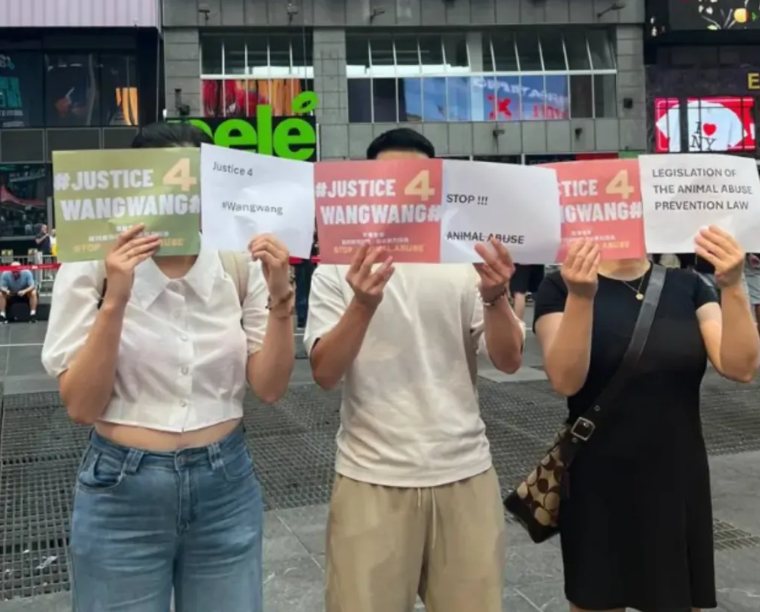
- Mid-July onward: Offline and online activism intensifies despite censorship. People buy and display posters and stickers (some available on Taobao) calling for animal-protection laws. Outdoor screens in cities including Shenzhen, Hangzhou, and Zhengzhou briefly run related advertisements before some are removed. Private chat groups discussing the case face police visits and warnings not to “incite or organise.” In at least one reported incident in Shenzhen, a person is stopped and scolded by subway security and police simply for wearing a backpack tag opposing animal abuse.
- International reaction: The story spreads globally. Petitions on Change.org and other platforms gather tens of thousands of signatures demanding justice and national legislation. Images of a Times Square digital billboard featuring Wang Wang circulate widely. Animal-protection organisations including OIPA and Humane World for Animals issue formal statements and letters to Chinese authorities. Reports also emerge of people in Thailand and Indonesia creating or seeking traditional amulets and curses directed at the perpetrators, reflecting deep cultural anger over the cruelty.
Why the Anger Would Not Die Down
Wang Wang’s case struck a nerve because it was not an isolated horror. Mainland China has no nationwide ban on animal cruelty, though some cities and provinces have limited local rules. Proposals for national legislation have been submitted repeatedly to the National People’s Congress without success. Combined with the fact that children under 14 generally face no criminal liability, the official outcome—placement in a specialised school—felt to many like no real accountability.
Local affection for Wang Wang made the crime personal. She was not an anonymous stray; she was a neighbour’s familiar dog who trusted humans enough to stay near her puppies rather than flee. When authorities claimed action had been taken yet evidence suggested the boys and their families continued largely unaffected, the public concluded the system had failed both the animals and the community’s sense of justice.
Censorship Meets Persistent Activism
Beijing’s usual online control mechanisms activated quickly. Keywords related to Wang Wang and animal protection were throttled or suppressed. Posts vanished, accounts were restricted, and offline coordination drew police attention. Yet the campaign adapted. Activists moved discussions to private groups (until those too were monitored), funded public screens, printed stickers and posters, and took the message overseas. The very act of trying to silence the story amplified it. Even mild symbols of dissent—such as a simple anti-abuse tag on a backpack—could draw intervention, illustrating how tightly authorities sought to manage public emotion around the case. At some point, the government outlets even tried to blame foreigners for this event…
The economic boycott calls against Jieyang and businesses linked to the area added further pressure. International attention, including the Times Square display, ensured the story could not be fully erased.
A Mother Dog Who Changed the Conversation
Wang Wang never asked to become a symbol. She was simply a stray trying to protect her young. Her death, and the boys’ decision to record and share it, forced a broader reckoning with the absence of legal protection for animals in China and the limits of accountability for young perpetrators. The outrage that followed—online, offline, and across borders—showed that many Chinese citizens and people around the world refuse to accept such cruelty as normal or inevitable.
As of late July 2026, calls for a national animal-protection law continue. Whether this case finally produces lasting legal change remains to be seen. What is already clear is that Wang Wang’s story refused to be buried. In death she achieved something rare: she made millions of people look directly at a painful gap in the law and refuse to look away.


 EN
EN  FR
FR